
Garage Door Spring Repair in Illinois
How garage door spring repair works in Illinois — torsion vs extension, matched pairs, sizing, cycles. Signs and safety. Call 123-456-7890.
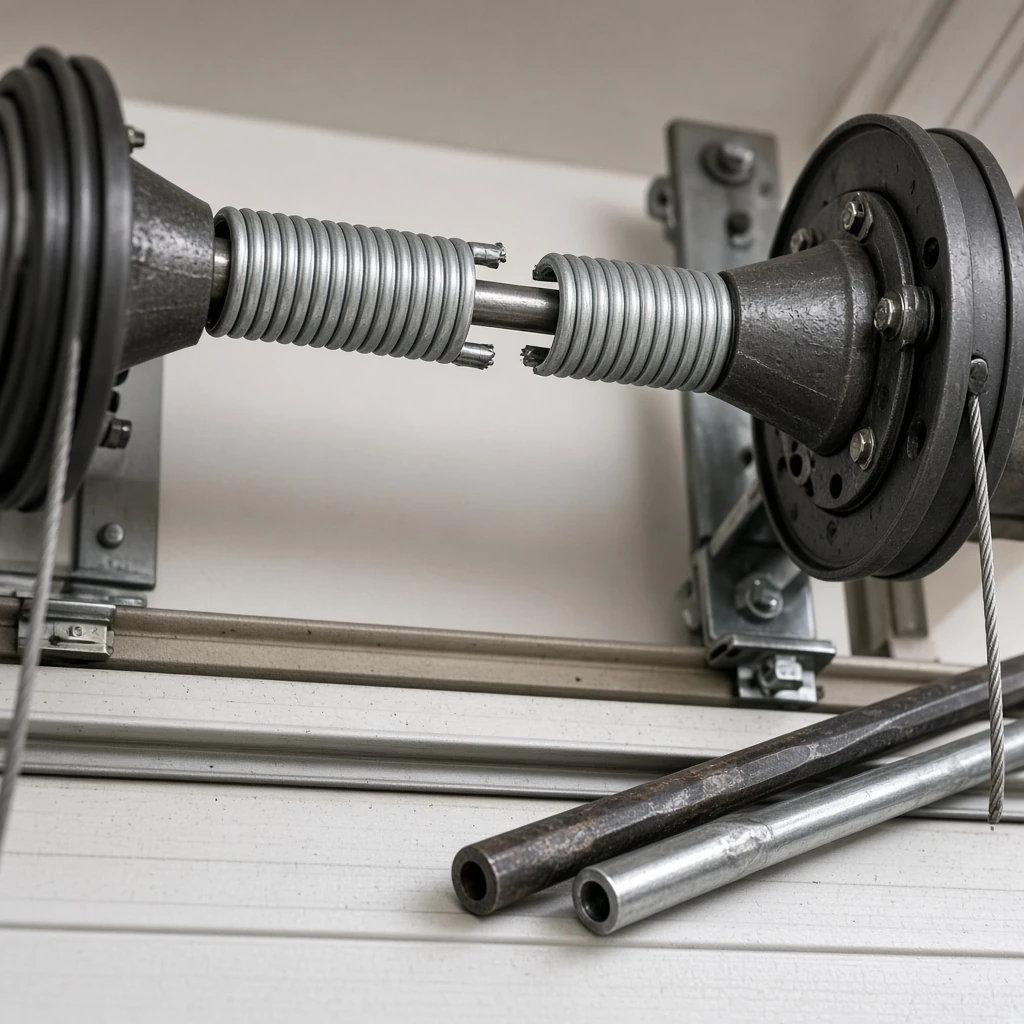
Garage door spring repair in Illinois is the most common winter call, because cold steel snaps. A torsion spring is rated for about 10,000 cycles — roughly seven years of normal use — and at Chicago's O'Hare station the January mean is 25.2°F with about 6.5 days a year at or below zero under NOAA's 1991–2020 normals, cold that makes an aging spring brittle enough to break. The springs, not the opener, carry the door's weight, so a failed spring strands the door and risks the opener. This page explains the spring systems, how repair works, and the safety reasons it is not a DIY job; the city pages list the companies that do it. Call 123-456-7890 to reach a local garage door pro.
The Two Spring Systems
Torsion Springs
Torsion springs mount on a metal shaft above the door and wind up as the door closes, storing the energy that lifts it. Most modern and heavier doors use them, often a matched pair on a double door. They last longer and control the door better than extension springs, and they are sized by wire gauge, inside diameter, and length to the door's exact weight. Because they are wound under high tension, they are the more dangerous spring to service.
Extension Springs
Extension springs run along the horizontal tracks above each side of the door and stretch to store energy. They are common on older and lighter single-car doors. A safety cable should run through each extension spring so a broken spring cannot fly across the garage — a cable a technician adds if it is missing. Extension systems are simpler but give less even lift than torsion.
What Spring Repair Covers
Spring repair replaces the failed spring and rebalances the door so the opener, and a person, can lift it easily. On a torsion system both springs are replaced as a matched pair, since they wear together. The cables, drums, and bearings that work with the springs are inspected at the same time, because a rough drum or a worn bearing will shorten the life of a new spring. The job ends with the door balanced to hold at any height and the opener's force reset to the lighter load.
Signs of a Broken or Failing Spring
The clearest sign is a door that is suddenly very heavy to lift by hand, or won't lift at all. Others include a visible gap in the torsion spring on the shaft, a loud bang heard from the garage, a door that opens a few inches then stops, a door that drops fast or slams, an opener that runs but barely moves the door, or a door that hangs crooked. A door opened many times a day, or a heavy insulated or two-car door, reaches these signs sooner because it burns through spring cycles faster.
How Spring Repair Works
First, the technician secures the door and safely releases the tension in the old spring with winding bars, since a wound torsion spring stores enough force to injure. Second, the old spring comes off and a new spring sized to the door's measured weight goes on — both springs on a pair, not just the broken one. Third, the spring is wound to the correct number of turns so the door is balanced and holds at any height. Finally, the cables, drums, and opener force are checked and the auto-reverse is tested before the job is done.
Why Illinois Springs Break
Illinois springs break because of cycles and cold together. Every open and close is one cycle against a roughly 10,000-cycle rating, so after years of use a spring is near the end regardless of climate. The cold then finishes it: steel loses flex as the temperature drops, so the brittle deep-winter weeks — about 6.5 days a year at or below zero at O'Hare — are when a tired spring finally snaps. Heavier doors make it worse. The wide two- and three-car doors common across the Chicago suburbs, and insulated doors, weigh more and load their springs harder, so they wear faster than a light single-car door and see frequent spring calls.
High-Cycle Springs — Worth It?
Standard springs are rated around 10,000 cycles; high-cycle springs rated for 20,000 cycles or more cost a little more and roughly double the life. For a door opened several times a day — a busy family, a home office, a door used as the main entrance — high-cycle springs are usually worth it, since they stretch the years between replacements. For a lightly used door they are optional. A technician can match the cycle rating to how the door is actually used.
Why Spring Repair Is Not a DIY Job
A torsion spring is wound under enough tension to break a hand or worse if it releases without control, which is why winding bars and the correct technique are essential and why this is the most-cautioned garage door repair. Beyond the danger, the spring has to be sized correctly — wrong wire gauge, diameter, or length leaves the door unbalanced and burns out the opener — and the door rebalanced afterward. The small savings on parts does not offset the injury risk and the likelihood of a wrong-sized spring. This is a job for a technician.
What to Look for in a Spring Repair Company
A spring repair company worth calling replaces both springs on a torsion pair rather than one, sizes the spring to the door's measured weight rather than a guess, adds safety cables to an extension system that lacks them, inspects the drums and bearings that wear springs, carries liability insurance with proof on request, and tests the door's balance and the opener's auto-reverse before leaving. A matched, correctly sized pair prevents a second failure weeks later. For rough figures, see the cost guide. Call 123-456-7890 to reach a spring repair pro in Illinois.
Frequently Asked Questions
On a torsion system with two springs, replace both. The springs wear at the same rate, so when one breaks the other is near the end of its life, and replacing only the broken one usually means a second service call within weeks and an unbalanced door in the meantime. A matched pair also keeps the door balanced evenly, which protects the opener. A single-spring system is replaced as the one spring. A technician confirms which system your door uses.
Yes, in two ways. A torsion spring under tension stores enough energy to cause serious injury, which is why winding and replacing one is not a DIY job. And a door with a broken spring is hazardous — it carries its full weight with nothing to counterbalance it, so it is far heavier than it looks and can drop on a car or a person. Leave the door down, keep people from under it, avoid the opener, and call a technician. Call 123-456-7890.
No. The spring carries the door's weight and the opener only guides it, so with a broken spring the opener pulls the full weight of the door and burns out the motor or strips the drive gear. Running it against a dead spring turns a spring repair into a spring-and-opener repair. Leave the door down until a technician replaces the spring as a matched pair, then the opener works normally again.
A standard torsion spring is rated for about 10,000 cycles, which is roughly seven years at normal daily use and less on a door opened many times a day. Illinois cold shortens the usable life because brittle steel is likelier to snap, and heavier insulated or two-car doors wear springs faster. High-cycle springs rated for 20,000 cycles or more roughly double the life for a small added cost. A technician can advise on the right rating for how your door is used.
Springs break on the coldest days because steel loses flex as the temperature drops, so a spring already near the end of its cycle life is most brittle exactly when it is coldest. At the O'Hare station there are about 6.5 days a year at or below zero under NOAA's 1991–2020 normals, and those are when spring calls peak. The spring was already near failure from use; the cold is the final push. Replacing both springs as a pair prevents a quick second break.
Replacing one torsion spring generally runs $150 to $350, and a matched pair runs $300 to $500, per 2026 figures from This Old House and HomeGuide. In the Chicago area, where labor runs about $90 to $110 an hour, a two-spring job typically lands in the $350 to $550 range. Heavier doors and high-cycle springs cost a little more. See the cost guide for the full breakdown, or call 123-456-7890 for a local figure.
Yes, and it is a common upgrade on older single-car Illinois doors. A torsion system gives more even lift, lasts longer, and controls a door better than extension springs, which matters as doors get heavier. The conversion needs a torsion shaft, drums, and mounting above the door, so it is more than a spring swap, but many homeowners choose it when extension springs fail on an aging door. A technician can tell you whether the opening has the headroom for torsion.
Call Now for Garage Door Spring Repair in Illinois
To reach a garage door spring repair company serving your Illinois town, call 123-456-7890.
Call now to reach a garage door pro in Illinois.
One call reaches a local company for repair, spring replacement, opener service, installation, and replacement. No forms — just a phone number.